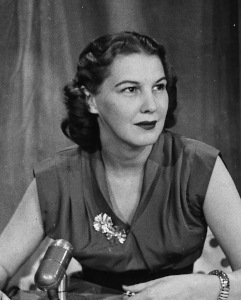
Martha Rountree: A Visionary in Public Affairs Television
In the nascent era of television, a pioneering spirit was needed to define its role in public discourse. Among the most influential of these innovators was Martha Rountree, a formidable journalist whose work not only shaped early news programming but also solidified the format of the televised press conference. While perhaps best known as the co-creator of the enduring *Meet the Press*, Rountree’s subsequent venture, *Press Conference* (later renamed *Martha Rountree's Press Conference*), stands as a testament to her unwavering commitment to bringing public affairs directly into American homes.
Rountree recognized the power of television to connect citizens with their leaders and the issues of the day. Her show, *Press Conference*, launched in mid-1950s America, was a direct evolution of the format she had helped popularize. It featured a prominent newsmaker – frequently a politician but sometimes other influential figures – who would face a panel of seasoned journalists. This setup mirrored the traditional press conference, allowing the subject to deliver an opening statement before engaging in a rigorous question-and-answer session. This structured yet dynamic format provided an unprecedented window into the minds and policies of those shaping the nation, setting a high standard for journalistic inquiry on the small screen.
“Press Conference” on Air: Navigating Early Television Landscape
Martha Rountree's *Press Conference* debuted on NBC in July 1956, a significant moment for public affairs television. However, the rapidly evolving television landscape of the 1950s presented unique challenges. The program soon moved to ABC in the fall of 1956, where it initially occupied a prime-time slot on Sunday nights. This scheduling placed it in direct competition with two of the era's entertainment behemoths: *The Ed Sullivan Show* on CBS and *The Steve Allen Show* on NBC. Unsurprisingly, a serious public affairs program, no matter how insightful, struggled to capture a mass audience against such popular variety entertainment.
Despite the minimal viewership numbers, *Press Conference* played a crucial strategic role for ABC. Broadcasters in the United States were subject to public-interest requirements set forth by the Federal Communications Commission (FCC). By airing a program of *Press Conference*'s caliber, ABC demonstrated its commitment to fulfilling these obligations, showcasing a dedication to civic engagement beyond purely commercial programming. This highlights an important aspect of early television: even niche, public-interest programs held significant value for networks looking to balance profit with public service.
The program's journey continued with a brief move to Sunday afternoons for three months in early 1957, a less competitive time slot. However, it returned to prime time in April of that year under a new, more personalized title: *Martha Rountree's Press Conference*. This rebranding underscored Rountree's personal brand and her undeniable influence on the program's identity and journalistic integrity. Ultimately, the show concluded its run in July 1957, having made a significant, albeit short-lived, contribution to the landscape of televised public affairs.
Beyond the Screen: Understanding the Modern Press Conference
While Martha Rountree pioneered the televised press conference, the format itself has a much deeper history and continues to be a cornerstone of modern communication. A press conference is fundamentally a formal media event where an individual, organization, or public official delivers a statement to invited journalists, typically followed by a question-and-answer session. This gathering serves as a critical conduit for direct communication between sources and the press, enabling the swift dissemination of announcements, policy explanations, or responses to pressing current events within a somewhat controlled environment.
The origins of the modern press conference can be traced back to the early 20th century, with U.S. President Woodrow Wilson often credited for initiating the practice in March 1913 as a structured means to engage reporters on presidential matters. The format further evolved significantly during the Eisenhower administration, establishing the more structured setting we recognize today, where a speaker responds to pre-selected or called-upon questions. The term "press conference" itself entered common usage in English between 1935 and 1940, signifying its growing establishment as a formal and crucial method of public communication. For a deeper dive into this rich history, explore From Wilson to Strategic Communication: The Press Conference's Evolution.
Key elements of a successful press conference include:
- Advance Notification: Journalists are typically invited in advance, with details on time, location, and topic.
- Opening Remarks: The spokesperson usually begins with a prepared statement or announcement, setting the agenda and delivering key messages.
- Question-and-Answer Session: This interactive phase allows reporters to pose questions, though the organizer often retains control over who asks questions and when to conclude the session.
- Controlled Environment: Unlike ad-hoc interviews, the collective setting allows simultaneous coverage by multiple outlets, ensuring a consistent message while providing opportunities for clarification.
Today, press conferences remain integral to political, corporate, and public relations strategies worldwide. They are designed to inform the public through media channels, generate news coverage, and, crucially, manage narratives during crises or significant announcements. This blend of transparency and strategic communication makes them a powerful, albeit complex, tool.
Mastering the Media: Strategies for Effective Press Conferences Today
In an age of instant information and social media scrutiny, the strategic importance of a well-executed press conference cannot be overstated. While the format has evolved since Martha Rountree's time, the core principles of clear communication and effective engagement with the media remain paramount. For any individual or organization considering holding a press conference, meticulous preparation is key.
Tips for a Successful Press Conference:
- Define Your Objective: What specific message do you want to convey? What outcome do you hope to achieve? Every element, from your opening statement to your answers, should align with this objective.
- Craft Clear Key Messages: Develop 2-3 concise, impactful messages that you want journalists to take away. Rehearse these until they feel natural and can be reiterated easily, even under pressure.
- Anticipate Questions (and Prepare Answers): Brainstorm every conceivable question, including challenging or adversarial ones. Prepare factual, calm, and consistent responses. This often involves media training for spokespersons.
- Select the Right Spokesperson: Choose someone articulate, knowledgeable, and calm under pressure. Their demeanor can significantly impact how your message is received.
- Choose an Appropriate Venue: Ensure the location is accessible, offers good lighting and acoustics, and has appropriate branding or backdrops. Audiovisual equipment (microphones, screens) should be tested beforehand.
- Manage the Flow: Have a moderator who can introduce the speaker, facilitate the Q&A, and keep the session on track and on time.
- Be Brief and Relevant: Respect journalists' time. Get to the point quickly, provide necessary details, and avoid jargon.
- Handle Difficult Questions Gracefully: Stay calm, don't get defensive. If you don't know an answer, commit to finding it out. Pivot back to your key messages where appropriate, but avoid stonewalling.
- Follow Up: Provide a press kit with relevant documents, press releases, and contact information. Be prepared for one-on-one interviews immediately following the conference.
While effective for rapid information sharing, press conferences can also amplify controversies if responses falter or if access is perceived as restricted. The tension between achieving transparency and maintaining message control is a constant challenge. However, when executed thoughtfully, they can be powerful tools for accountability, public education, and shaping public perception. Understanding their strategic significance is crucial in today's media-saturated world. Discover more about their ongoing relevance in Why Press Conferences Matter: Managing Messages & Shaping Public News.
Conclusion
From the pioneering efforts of Martha Rountree on public affairs television to their indispensable role in modern strategic communication, the press conference has proven to be an enduring and adaptable format. Rountree's foresight in bringing this direct form of journalistic inquiry to a mass audience laid foundational groundwork for how we consume news and engage with public figures today. While her show faced the uphill battle of balancing public interest with entertainment in television's early years, its legacy underscores the critical importance of serious journalism in a democratic society. Today, whether televised, live-streamed, or held in person, the fundamental purpose of a press conference remains the same: to facilitate direct communication, disseminate information, and navigate the complex interplay between transparency, accountability, and message management.